A Course for Collaborative Ecologists
Ecological synthesis: So you have an idea… What next?
Workshop offered at the ESA 2026 annual meeting in Salt Lake City, UT
Date: 2026-07-27 | Time: 1:30-3:00pm MDT | Room: 355F | WK 03 Program Link
Abstract
In recent decades, ecology has become a more collaborative discipline motivated by the search for generality across ecosystems. At the same time,the availability, quantity, and quality of environmental data have grown rapidly, creating opportunities for re-use of these data in ecological synthesis research. Though synthesis research is complex and demanding, taking an inclusive and collaborative approach to both the scientific process and the data pays dividends throughout the lifetime of a project. In 2026, we are offering a workshop, focusing on refining a synthesis-relevant question, building and stewarding a team of collaborators, and identifying the applicable data.
The full short course, which we offered in 2025, is a survey of methods for making ecological synthesis research a “team sport”, and all the materials remain available on this website.
Objectives for learners are:
- gain team science and project management skills that are needed for synthesis and that are immediately useful in a research team setting,
- locate and become familiar with resources to gain the data science skills needed for reproducible synthesis
- focus on developing their own synthesis projects, whatever stage they are in, through interaction with instructors and peers.
Instructors will cover an overview of the synthesis process, assembling the team, identifying and refining the question(s), collecting primary data sources, and project management. The course uses real-world examples, demonstrations, and interactive lessons in small groups. Ecologists with synthesis experience will be on hand with seasoned research advice and data tips.
Workshop Materials
Click here
Ecological data synthesis: a primer on essential methods for team science
6-hour short course offered at the ESA 2025 annual meeting in Baltimore, MD
Date: 2025-08-10
Abstract
In recent decades, ecology has become a more collaborative discipline motivated by the search for generality across ecosystems. At the same time,the availability, quantity, and quality of environmental data have grown rapidly, creating opportunities for re-use of these data in ecological synthesis research. Though synthesis research is complex and demanding, taking an inclusive and collaborative approach to both the scientific process and the data pays dividends throughout the lifetime of a project. This short course is a survey of methods for making ecological synthesis research a “team sport”.
Objectives for learners are:
- gain project management and data synthesis skills that are immediately useful in a research team setting,
- develop an end-to-end (conception to publication) plan for collaborative synthesis research and
- focus on developing their own synthesis projects, whatever stage they are in, with guidance from instructors and peers.
Instructors will cover assembling the team, study design, communication, collecting primary data sources, assembly/harmonization of data, managing analytical workflows, and publication of derived datasets and other synthesis products. The course uses real-world examples, demonstrations, and interactive lessons in small groups. Ecologists with synthesis experience will be on hand with seasoned research advice and data tips.
Agenda for 2025-08-10
This agenda is subject to change!
| Timing (PT) | Content |
|---|---|
| 9:00 - 9:30a | Welcome & Introductions |
| 9:30 - 10:30a | Module 1: Starting with Team Science |
| 10:30a - 12:00p | Module 2: Operational Synthesis |
| 12:00 - 1:00p | Break |
| 1:00 - 2:00p | … Module 2, continued … |
| 2:00 - 3:00p | Module 3: Tying it all together |
| 3:00 - 4:00p | Mentoring session… |
Introductions & Icebreaker
Before we begin, we’d love to get a sense for who you all are and why you’re interested in synthesis work! To that end, we’ll take a few minutes and go around the room for introductions. Please include:
- Your name and pronouns
- A 1-sentence summary of your work
- Briefly, why are you interested in synthesis?
Instructors
- Marty Downs
- Jalene Lamontagne
- Nick Lyon
- Greg Maurer
- Eric Sokol
Code of Conduct
Briefly: Treat all participants with kindness, respect, and consideration, valuing a diversity of views and opinions. Report unacceptable behavior at (844)-641-4133 or email codeofconduct@esa.org
Workshop Materials
Ecological data synthesis: a primer on essential methods
3-hour short course offered at the ESA 2024 annual meeting in Long Beach, CA”
Date: 2024-08-04
Abstract
In recent decades, ecology has become a more collaborative discipline motivated by the search for generality across ecosystems. At the same time, the availability, quantity, and quality of environmental data have grown rapidly, creating opportunities for re-use of these data in ecological synthesis research. Though synthesis research is complex and demanding, taking an inclusive and collaborative approach to both the scientific process and the data pays dividends throughout the lifetime of a project. This short course is a survey of methods for making ecological synthesis research a “team sport”.
Objectives for learners are twofold:
- Develop an end-to-end (conception to publication) plan for collaborative synthesis research
- Gain data synthesis skills that are immediately useful in a research team setting.
Instructors will cover assembling the team, study design, communication, collecting primary data sources, assembly/harmonization of data, analytical workflows, and publication of derived datasets. The course uses real-world examples, demonstrations, and interactive lessons. Ecologists with synthesis experience will be on hand with seasoned research advice and data tips. Many workshop activities will be oriented toward helping learners develop their own ideas and plans for ecological data synthesis.
Agenda for 2024-08-04
This agenda is subject to change!
| Timing (PT) | Content |
|---|---|
| 1:00 - 1:15p | Welcome & Introductions |
| 1:15 - 2:15p | Module 1: Starting with Team Science |
| 2:15 - 3:00p | Module 2: Operational Synthesis |
| 3:00 - 3:15p | Break |
| 3:15 - 4:00p | Module 3: Tying It All Together |
Introductions & Icebreaker
Before we begin, we’d love to get a sense for who you all are and why you’re interested in synthesis work! To that end, we’ll take a few minutes and go around the room for introductions. Please include:
- Your name and pronouns
- A 1-sentence summary of your work
- Briefly, why are you interested in synthesis?
Instructors
- Angel Chen
- Marty Downs
- Stevan Earl
- Nick Lyon
- Greg Maurer
- Eric Sokol
Code of Conduct
Briefly: Treat all participants with kindness, respect, and consideration, valuing a diversity of views and opinions. Report unacceptable behavior at (844)-641-4133 or email codeofconduct@esa.org
Workshop Materials
Note on Course Materials
We’ve chosen to assemble these materials as a living website so that we can revisit and improve the materials over time. So, we recommend that you save the link to this site so that you can have easy access to these materials now and as they are refined going forward. Also, much of the content is covered more completely in our year-long synthesis course: Synthesis Skills for Early Career Researchers (SSECR).
If you are a GitHub aficionado, we have deployed this website via GitHub Pages so you could also “star” the website’s repository. Simply click the GitHub octocat logo on the right side of the navbar (at the top of the screen) to be redirected to the GitHub repository underpinning this website.
Credits
The course and its content were developed by a large team. See the People page to learn more.
Supported by:


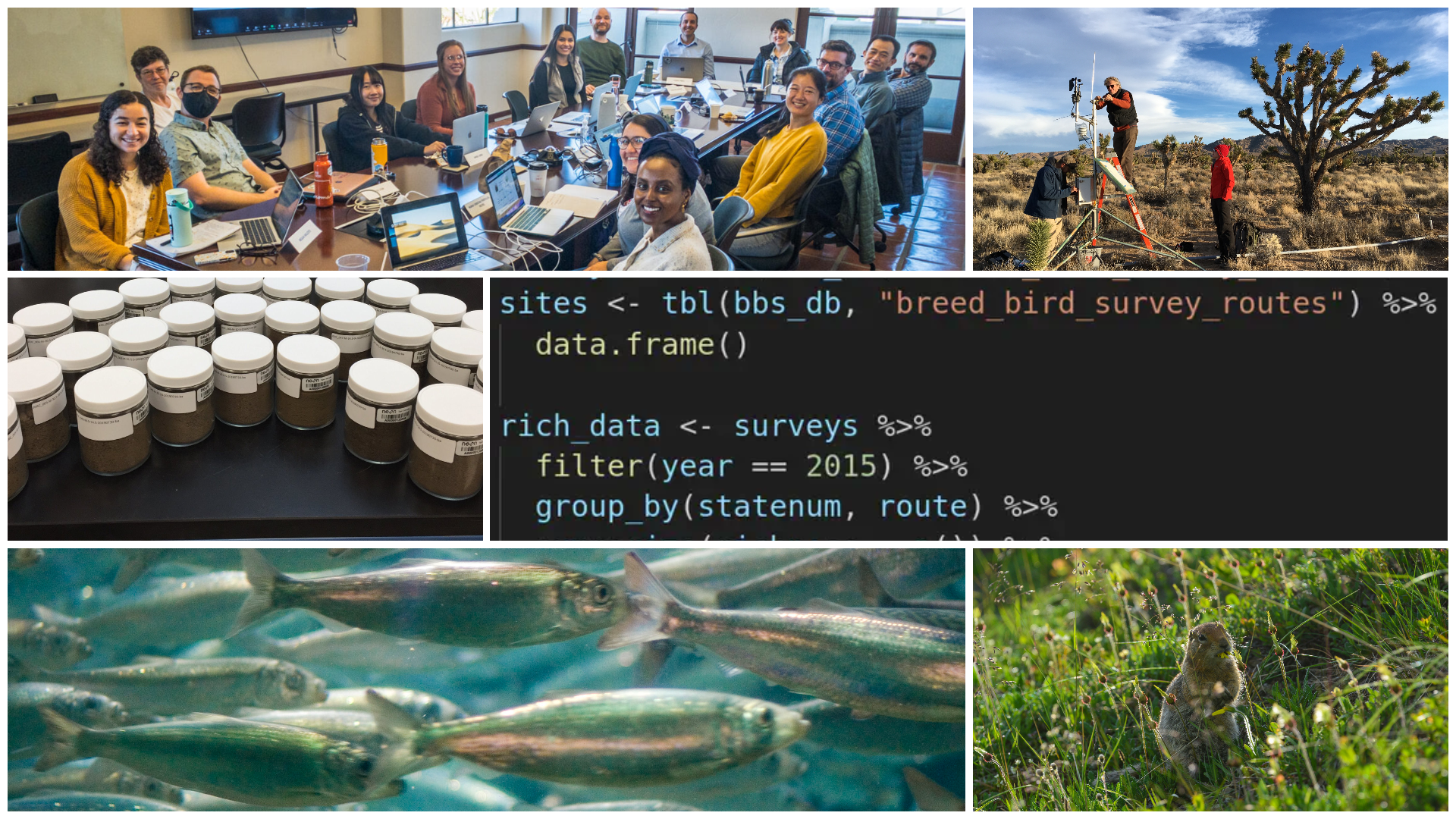
Collage photo credits: Jacob Bøtter via Flickr, CC BY-SA 2.0 | Jeremy Yoder via Flickr, CC BY-SA 2.0 | Marco Pfeiffer, CC BY-SA 4.0 | Gabriel De La Rosa, CC BY-SA 4.0 | Weecology lab CC BY 4.0 | NEON (National Ecological Observatory Network)